
By Matt Loeschman | Daily Independent (abridged)
Arizona is adding people, but the state’s households are not necessarily getting bigger.
Across the state, hundreds of thousands of Arizonans live in homes by themselves — a trend that reflects changes in marriage, family formation, housing and the state’s rapidly aging population.
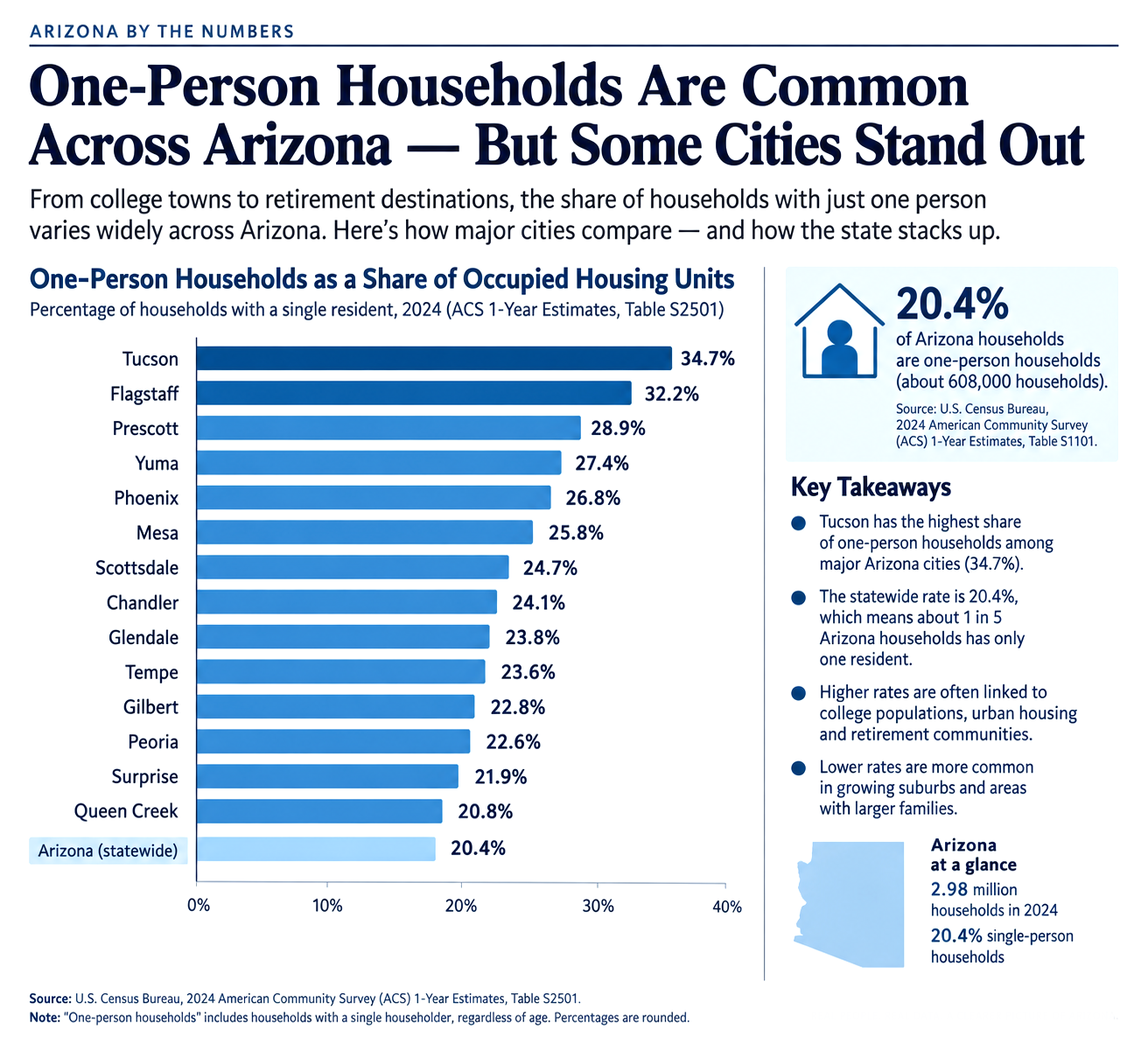
The latest U.S. Census Bureau American Community Survey estimates that Arizona had about 2.98 million households in 2024. Of those, 20.4% were households in which the householder lived alone, or roughly 608,000 one-person households. Put another way, about one in five Arizona households consists of a single resident.
For some, living alone is a choice that comes with independence. For others, particularly older adults, it can be the result of widowhood, divorce or the loss of family members. And for younger adults, it can be part of a longer transition before marriage or starting a family.
The result is a demographic shift that is changing what an Arizona household looks like.
A different picture from city to city
Living alone is not distributed evenly across Arizona.
Tucson, for example, has a large number of one-person households. The city’s combination of a major university, an established urban core and a substantial rental market creates a different household pattern from some of the state’s newer suburban communities. The 2024 Census ACS estimates that 34.7% of occupied housing units in Tucson were one-person households. The same Census table shows that more than 80,000 Tucson households were occupied by people living alone.
That is a striking contrast to the image of Arizona’s newer suburbs, where neighborhoods are often dominated by larger homes designed for families.
The differences also extend beyond the state’s largest metropolitan areas. Retirement-oriented communities can have substantial numbers of people living alone, while areas with younger families tend to have larger households.
The Arizona Office of Economic Opportunity estimates that nearly one-fifth of the state’s population is already 65 or older. OEO projects that the share will increase to about 22% by 2035. That aging trend could make one-person households increasingly important to Arizona’s demographic picture.
Original post (subscriber content)
Related:
- The Census Bureau’s 2024 ACS estimates that 14.7% of all Scottsdale households (17,416 HHs) are headed by someone who is 65 or older and living alone.
- Scottsdale Housing Analysis & Panel | Nov. 17, 2026